

Leer en Español
Un error de traducción que puede ser mortal (literalmente)
Sometime ago, I’ve received an invitation to participate in a discussion in one of the Linkedin groups we belong to. Members of Portada, a source on Marketing and Media to Hispanics were having quite an interesting exchange on a machine translation gone very wrong.
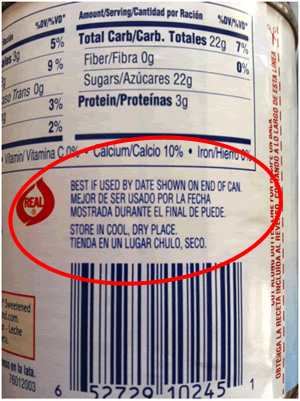
A pharmaceutical lab had placed a bilingual label on the container of one of their drugs, sporting one of the worst spanish translations I had my displeasure of reading. While the label read in English, “Best if used by date shown on end of can”, the Spanish line suffered a translation “Mejor de ser usado durante la fecha por el final del puede”. Not being enough, the whole jest arrived to the grand finale of the English line “Store in cool dry place”, while the translation in Spanish was printed as “Tienda en un lugar Chulo, Seco”.

Click the image to enlarge
After I calmed down from the initial surprise, I’ve got to pondering on how many levels of wrong, this short translation was resting. Many members of the forum were rightfully indignant at the obvious disregard for the native language of the intended audience; that was just the beginning. The Spanish translation of the label didn’t make any sense. It was evident that this was an automatic translation that was never reviewed or corrected.
What made it worst was the presence of the word “chulo”, that according to the geographical background of the Hispanic reader, it could be translated as “nice”, “beautiful” or “pimp”.
It appears that the translation software that the pharmaceutical company used, translated cool = nice = chulo and it did not construe the right meaning on the usage of the word “cool”, in reference to temperature, or that the human operator that surely was sleep at the wheel. In any case, the word should have been translated as “fresco”.
In addition, whatever software they have used, was just laying the translations literally and literally wrong. The meaning of the words “store” and “can” were also translated completely wrong; the first being a verb and the second a subject. Even Google got the whole translation 98% right!
Now, I don’t want to paint the automatic translation or wholesale translations as the bad guys of this post. The fault lies with people that are shortchanging Spanish translation with obvious disregard for the correct syntax and usage of the language. I can continue listing errors in these two sentences, but as I do not want to turn this into a grammatical lecture, I will just touch on the surface of what bothered me the most; the blatant disregard of sound judgment that this pharmaceutical company exhibits to their intended customers.
Leaving aside the lack of respect to their Hispanic clients, I find myself pondering that this is more a safety issue. Today, we are only talking about the translation errors on a couple of directions on the medicine storage indication, but how many prescriptions labels could have come from this same pharmaceutical company with graver errors and more importantly, how many of those labels could contain the erroneous translation of the Dosage section or the Indications section. That really makes my skin crawl.
It is my guess that these kinds of companies make enough profits. Can they not hire a real human Spanish Translator to at least appeal to a market they are intent on marketing to?
Dear pharmaceutical, this kind of translation error cannot be taken lightly as an error here could cause illness of even death to a person!


[…] por Hermes Read in English A translation error can be deadly (literally) […]
This is so funny! I dont understand why companies use MT and not reputable Spanish translators… If they want to reach a bigger market, they should start by having an accurate translation…
I have no idea James.
I know that machine translation is getting smarter and is here to stay, but it should be used at it was intended: just as a tool, not as the solution itself. I guess the problem ultimately lies with the operator, saving time, cutting corners.
Even Google advises not to use automated translation fo your goals, especially in SEO campaigns. We wrote about it some time ago https://translatetranslations.com/2011/03/google-automated-translations-bad-website-ranking/ I invite you to discuss it there.
Cheers,
[…] A translation error can be deadly | TranSlate Translations Spanish translation gone very wrong.Automatic translation errors like these could cause illness or even death to a person if not reviewed… Source: translate-translations.com […]
[…] A translation error can be deadly | TranSlate Translations Spanish translation gone very wrong.Automatic translation errors like these could cause illness or even death to a person if not reviewed… Source: translate-translations.com […]
[…] the negative publicity over and over again. The situation is as bizarre as the following quote from TranSlate Translations -blog discussing about a serious translation mistake on a drug […]
[…] A translation error can be deadly | TranSlate Translations Spanish translation gone very wrong.Automatic translation errors like these could cause illness or even death to a person if not reviewed… Source: translate-translations.com […]
[…] A translation error can be deadly | TranSlate Translations Spanish translation gone very wrong.Automatic translation errors like these could cause illness or even death to a person if not reviewed… Source: translate-translations.com […]
If this pharma company can be as stingy as this to save literally a few dollars, it surely must be cutting corners in the drug manufacturing process.
Pathetic! And here I am desperately looking for translation work…
I agree with the IM translator, i used it for English-Portuguese and Poruguese-English and the back stantlarion tool of IM is very helpful. i don’t speak Portuese myself, but with my knowledge of French with a little bit of fantasy those languages are related and my very poor Portuguese, it makes quite sense it’s not perfect, but Babelfish and Google indeed suck
Yeah such translation errors can dangerous. So thats why i don’t trust translation for such things. Just for translating some texts it’s okey.
I love the comment: “illness of even death to a person!”. This is a worse outcome than just an ordinary ilness, but a slightly better outcome than an uneven death, God forbid!
This is pretty much in-line with what we’re tnihking too.We’re planning to charge the full amount of the translation from the client when submitting the job. Then, the translator goes through each sentence. If the translator can copy/paste from the current translation, we’ll bill for something like 30% (for that sentence). Otherwise, if there’s any edit, we bill for 100% of the translation.At the end of the translation, we’ll refund the client’s account according to the parts of the text that didn’t require translation (70% refund for copy/paste).If we first get the document, then go through it, then give a quote and wait for the client’s approval, we’re creating a pretty big process. This is why we would prefer to charge for the entire work and refund at the end.These documents would always be part of larger projects. Most of the work is for translation from zero, and only a part of it includes updating existing translation.Does this make sense?
Sometimes in Spain we have the same problems with “automatic translations”.
Good article.
Cheers.